LEA SYMBOLS®
for Near and Distance Vision Screener
#252000 - #259900
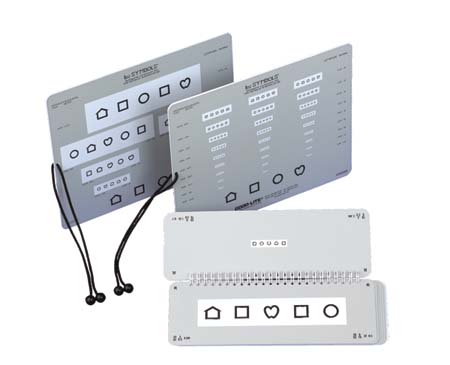
The LEA SYMBOLS® Near and Distance Vision Screener tests were designed for screening but they have become useful also as the easiest line tests because they are faster to use than the standard test (#250800). However, the standard test (#250800) is also important for assessment because the tightly crowded tests on its reverse side help detect problems associated with keeping details apart.
The most effective vision screening for detecting lazy eye (amblyopia) uses near and distance tests. When testing children younger than 4 years, testing is a lot easier if children have had an opportunity to play with the test symbols before the test situation. This can be arranged by including the test symbols in the information sent or given to parents as an invitation to participate in the screening examination. Parents can play the LEA SYMBOLS® game at the LEA-Test homepage. Just prior to the testing, children can play with the LEA 3-D Puzzle.
Near vision is functionally more important than distance vision in the life of a young child. The child is also more accustomed in using vision at near than at greater distances. Therefore introduction of the test at near familiarizes the child with the test situation. Young children are easier to test at near than at distance of 3 meters (10 feet). In the rare case of myopia you will find that the child has useful vision at near and parents (and you) will not be alarmed when the child does not see well during the distance test.
The target population of amblyopia screening, like any screening, are symptom free children. If a child has symptoms of any kind (strabismus, squeezing eyes during testing, head tilt or turn, itchy or red eyes etc.), he is referred for treatment independent of visual acuity values.
The LEA SYMBOLS® Screeners look different than the other LEA SYMBOLS® tests. The grey background was chosen for two reasons: 1. In developing countries dust will show less on the test during the day; the tests can be washed in the evening, and 2. since there is less white surface, the test does not dazzle photophobic children.
The test lines are wider apart in the screener near vision card than in the standard test (#250800). It makes it easier for both the tester and the child to know on which line to read. Therefore testing becomes more relaxed and is faster. In the distance tests there is only one line visible on each page and there are two pages of each size. This way if the child makes several errors on a certain line but immediately corrects some of them, the tester can ask the child to read the other line of the same size “slowly, no hurry”.
Instructions for near and distance testing
Establish a method of communication such as pointing on the symbols on the key card or the LEA 3-D Puzzle board (matching) or naming (signing). Decide with the child which names will be used to identify the symbols. When needed, train with the LEA 3-D Puzzle (#251600) or the Response Key Card (#251700).
Start with binocular testing at near. Point to each of the four symbols (circle, house, apple, square) on the top line of the near card; observe the baseline responses for comprehension, speed and accuracy.
Ask the child to identify only the first symbol on each line.
Repeat this procedure for each or every second line (moving quickly down the near card to avoid tiring the child; in distance testing move to the next size, flip two pages) until the child hesitates or misidentifies a symbol.
Move back up one line and ask the child to identify all the symbols on that line.
If the child identifies all symbols correctly go to the next line down and ask the child to identify all the symbols on that line. The child may have focused the image more carefully and therefore can read symbols that were not seen a moment earlier.
If the child skips a symbol, ask the child to try again while briefly pointing to that symbol. Do not leave your finger or a wooden stick (never a pen or pencil) at the symbol because it gives a visual reference and may improve fixation of an amblyopic eye.
If the child does not function well in the test situation at near, let him train by using the training test that you can print using this link or the link at the Info for Parents on the homepage www.lea-test.fi. If a 3-year-old child does not cooperate after 2-3 weeks of training, the child needs to be referred. The reason for poor cooperation may be that the child does not see the symbols! Therefore, before a diagnosis of delayed intellectual development is made, it is necessary to know that sensory functions are normal, including other visual cortical functions and hearing.
Testing at distance of 3 meters (10 feet)
After near testing introduce the distance chart to the child by saying, "Let's look at the same pictures a little further away“. Move the chart gradually back to 3 meters (10 feet), while watching the child for signs of inattention. If the child loses interest, move closer to 1.5 meters (5 feet), or one meter (40 inches). Always test well within the cognitive visual sphere of the child, the space within which the use of vision is possible. Older children may be switched directly from a near vision test to the 3 meter chart.
After binocular testing, proceed with testing each eye separately. In screening, use two pairs of plano glasses for occlusion of the child's eyes or the special screening frame with only one opening in the frame (Figure 2.) It can be used for covering both eyes, one at a time. This is the least disturbing type of occluder. The deep purple frame is most popular.
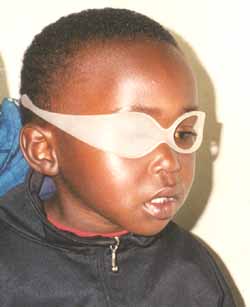
Figure 2.
For monocular testing, follow the same procedure as for binocular testing.
If the near vision card is held at 40cm (16 in) and the distance visual acuity test at 3 meters (10 feet) the visual acuity value is found in the margin adjacent to that line. The visual acuity is recorded as the last line on which at least 3 of the 5 symbols are read correctly.
Always test until the threshold line so that you can measure the difference in visual acuity between the eyes.
The tests are supplied with a response key. For convenience, the near vision card has a response key line at the bottom. However, naming is a much faster way of responding and you can hear when the child becomes hesitant or starts to lose interest.
Monocular near vision testing
As a part of vision screening, monocular testing at near is often possible much earlier than testing at distance. In testing young children this may be the only way of measuring monocular values.
If visual acuity at distance has become less than it was at age 4 or if there is difference between the two eyes, near vision measurement may give the following diagnosis: If the near vision values are symmetric and better than the values at distance, the change in distance vision cannot be caused by anything else but mild myopia, which does not need to be corrected. The child does not need to be referred. This leads to a decrease in the expenses of vision screening and simultaneously leads to an improvement in the quality of screening.
If there is decrease in both the distance and the near vision acuity, the most common reason is a change in refractive error but it may be caused by a disease. Therefore, the child needs to be referred.
Pass/fail criteria
Pass/fail limits are used in a number of amblyopia screenings. It decreases the sensitivity of the test.
If the child has visual acuity 0.8 (20/25, 6/9) in one eye and 0.5(20/40, 6/12) in the other eye, the difference in visual acuity values between the eyes will not be detected if a pass/fail criteria of 0.5 (20/40, 6/12) is used.
At the age of four years, most western countries use a pass/fail criteria of 0.5 (20/40, 6/12) for binocular visual acuity to detect large refractive errors and previously undetected cases of binocular visual impairment that might affect the child’s general development.
On the other hand, a pass/fail limit of 0.8 (20/25, 6/9) at the age of six years does not seem to pick many children who have refractive errors that should be corrected, if children are screened at the age of four years. However, this is an important age to detect problems in processing of visual information.
In school age the passing limit should not be one single visual acuity value but based on the vision needs of a particular child: If the child is in the shortest or the middle third of the class and if (s)he can sit close to the podium, binocular visual acuity of 0.2 - 0.3 (20/100 - 20/60, 6/30 - 6/18) may cause no difficulty in the class room. On the other hand if the child is tall and is required to sit far from the blackboard, visual acuity of 0.8 (20/25, 6/9) may be required for normal working in the classroom. If children are referred at a time when they have only mild myopia, the referral expenses are high. In many places children are prescribed these weak glasses that they do not need. This is a sizeable extra cost to the families.
It should be clearly remembered that vision screening after the age of 8-9 years is arranged to find those children who may need glasses in order to see well in the classroom. We are not looking for amblyopia or diseases and therefore the deciding fact is whether the child sees well enough in the classroom or not.
Screening is not assessmentI would like to stress that the age-normal visual acuity values determined in vision screening do not guarantee that vision is normal. Brain-damage-related vision loss (CVI), retinal degeneration, or optic nerve lesions may not affect visual acuity at high contrast but may have cause loss of vision at low contrast or visual field defects or disabling losses of visual perception. Vision changes related to brain damage and eye or pathway disorders should be better known because today it may take years before a child is referred for intervention and services of special education. Vision screening is not enough for follow-up of children with special needs. If the child’s family, teacher, or therapist notices a change in the child’s functioning that could be related to vision, the child with a learning disability or with motor, intellectual, or auditory disability needs to have a thorough assessment covering all the areas that are known to change in each condition. These children need to have repeated, specific, thorough functional vision assessments also in the school age years. |
M-unit, metric unit is the distance in meters at which the reference optotype C is seen at a visual angle of 5'.
[ Instructions I Paediatric Vision Tests I Vision Tests ]
This document was last modified on