LEA 3-D Puzzle
#251600
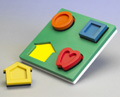


Among the picture tests the LEA SYMBOLS® test is the only test with optotypes calibrated with Landolt C and so abstract in their forms that they are close to letters in recognizability if the abstract names “circle”, “square”, “pentagon”, are used. Yet, if we use the names of pictures of concrete objects, “ring”, “window”, “apple”, “house” or any other name of concrete objects, they can be recognized at an earlier age than the fully abstract letters and numbers. In vision screening, preschool and school-aged children can thus be tested using LEA SYMBOLS® charts and single symbol tests until calibrated letter (ETDRS) or number (LEA NUMBERS®) charts can be used.
The LEA 3-D Puzzle is designed for training and assessment of normal infants, and children and adults with motor problems of hands. The puzzle is also a tool in neuropsychological assessment of patients with brain damage. If the child cannot grasp the puzzle pieces but can grasp a champagne bottle cork, you can use the bottle cork to make it possible for the child to “grasp” small things like the puzzle pieces: glue a small flat magnet on the cork and on the puzzle pieces and the child can move the puzzle pieces using the champagne bottle cork as a handle.
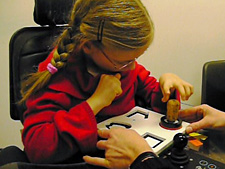
The aim in the play training of infants and young children is to help them to develop the concept same/different as a prerequisite for measurement of visual acuity much earlier than is possible without training with this educational toy.
When a child is learning the concepts similar - different comparing colours and forms, a simple puzzle is an age appropriate toy that at the same time prepares the child for vision testing. The LEA 3-D Puzzle should be kept on a shelf like a book that is taken from there only for a special play activity.
 |
 |
 |
| Video 1 | Video 2 | Video 3 |
 |
 |
 |
| Video 4 | Video 5 | Video 6 |
Some children with delays in their development may use the LEA 3-D Puzzle for several months, sometimes years, before they develop the concepts that we need in vision testing.
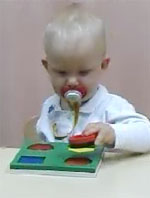
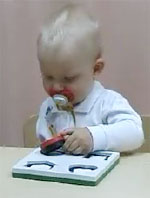
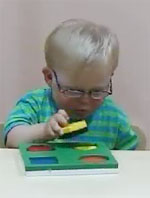
A 10-11 month-old infant will put the puzzle pieces in his/her mouth and bang them. Give only the square and the round puzzle pieces at this stage and also during the next stage when the child starts to drop or to throw the puzzle pieces, often throwing the puzzle board also. This is a recognized phase in the normal development of auditory space; the child is not mischievous. Since the board is heavy, it may break something if thrown with force; so, watch the child and rescue the board before it is thrown or catch it in midair. LEA 3-D Puzzle is an educational toy and is used only with the supervision of an adult person.
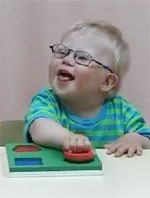
At the next level of development the child starts to study the cut-outs of the puzzle and may by chance put the round, orange puzzle piece in the orange cut-out, later the blue square puzzle piece into the blue cut-out. When the child repeats this activity and starts to do it with obvious intention, let him/her try the apple and house puzzle pieces that require better motor skills and awareness of directions than the circle and the square.
Do not teach the infant the placing of the puzzle pieces! Do not rob him/her the thrill of creating understanding that colours can mean “same” or “not same”. It is enough to say in passing when you take the toy from the shelf: “I take the puzzle pieces from their cut-outs on the table so that we can play with them”. Similarly when ending the play situation say: “I put the puzzle pieces in their cut-outs so that they can rest until tomorrow.” Watch whether the infant follows your hand movements, which is an important normal ability for learning to copy movements especially during the first year when motor coordination develops rapidly.
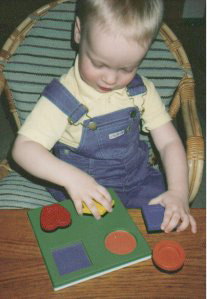
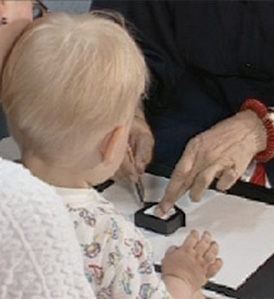
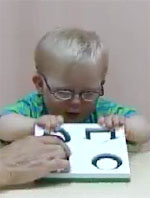
When the child can place all four coloured pieces in their cut-outs, introduce the black and white side starting again with the circle and the square. When the child masters placing the black-and-white puzzle pieces in their cut-outs, introduce the concept of pictures representing objects by drawing around the puzzle pieces and studying with the child the resulting picture and the fact that the pieces can be placed on it.
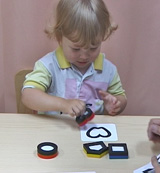
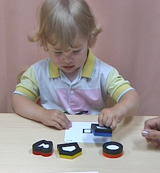
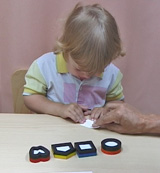
When the child starts to place the puzzle pieces on the drawn big pictures, introduce smaller pictures of these forms using the LEA Playing Cards or the LEA Domino Cards. When the child starts to place the puzzle pieces on the smaller pictures he is ready to be tested using these single symbol tests, later the LEA SYMBOLS® line tests for near (#250800 or #252000), and still later for distance with single symbol tests (#250600 or #252700), and with test charts (#259900, #250250 and still later with #250150). This development usually happens between 18 and 24 months for the near vision tests and thus visual acuity can be measured more than a year earlier than has been customary.
Training of the concept similar/different follows the same pattern in the early habilitation of visually impaired infants and in assessment of vision of children with multiple impairments. Children with brain damage related visual impairment may learn to match colours but may have much greater difficulties in learning to match forms, or may be unable to learn it due to specific loss of perception of geometric forms. Some children may learn to match the black-and-white forms during a half an hour play therapy but forget the concept as soon as the activity ends. They are unable to store the new knowledge in their long-term memory.
During play it is also possible to observe such functions as orientation in egocentric space and eye-hand coordination. A child may have problems in turning the puzzle pieces to fit the cut-outs. If the child has motor problems, allow enough time during the task to assess whether the slow motor performance is a pure motor problem or whether the child also has problems with visual planning or visual feedback.
Video recordings are helpful in the assessment of eye-hand coordination problems by revealing the great variation in responses of children with brain damage during this matching game. Videos are thus useful teaching materials.
Instructions for testing
-
Start on the colourful side of the puzzle board and puzzle pieces. If the child has not seen the puzzle before, hold the puzzle within the reach of the child, place the round piece on the board and go on chatting with the child and his mother on other subjects while watching the child's response. Give the child time to examine the puzzle piece and the cutouts. Do not suggest placing the piece in the cutout. If the child places the round puzzle piece in its cutout, say "there it went" without making more noise about it, take the round puzzle piece and place the square puzzle piece in the middle of the puzzle board. If it is placed in the correct cutout, take it and give the "apple" saying "what about this, where does it go" and if it is placed correctly, give the "house".
-
When assessing an older child who is likely to be able to match colours, ask simply 'Have you played with this puzzle before?'
-
Watch the eye-hand coordination and turning of the puzzle pieces to learn about visual guidance of motor functions and how much the child uses tactile information to find the correct orientation of the puzzle pieces.
-
If a child has major motor difficulties, play the usual way first and then so that the child does not look at the puzzle but uses tactile information and visual memory of the structure of the board.
-
If the child does not start matching the puzzle pieces he will need more exposure in play situations. It is better for the child to figure out matching or to observe another child playing instead of being taught that the pieces can be placed in the cutouts.
-
When the child can place the puzzle pieces in the cutouts on the colourful side, turn the board and let the child find out what to do with the black-and-white pieces. You might say 'There is an other side of this game.' The child usually grasps a puzzle piece, turns the colourful side up and then places it in its cutout, maybe using visual memory of the location. To find out that, turn the board 90 or 180 degrees while the child is reaching for the next puzzle piece. Next time when you play the game, turn the board 45, 90 or 180 degrees while turning it from the colourful side to the black-and-white side.
To record the child's ways of solving the problems in this test situation, keep a video camera running. To disturb as little as possible, place the camera on a tripod farther away and choose the frame large enough to show both the face and the hands of the child. Soft music can be used to cover the sound of the camera. If you can connect the camera to a TV behind the child you can watch that the child does not lean outside the picture area or you can widen the picture area.
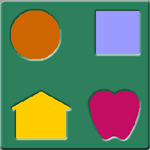 When a child places the puzzle pieces in their colourful cutouts with ease but has obvious difficulty when matching the black-and-white-forms, play the computer game LEA 3-D Puzzle to find out whether forms can be perceived when colours are used but the colours of the forms differ. The child cannot use colour matching but has to perceive the form to match.
Special use of the Puzzle board
The LEA 3-D Puzzle board used as the key card. The child responds using tactile information and can thus keep fixation on the test.
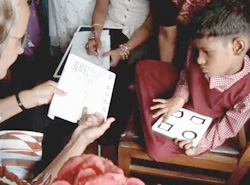
This child had great difficulties in fixation and in moving fixation from the test to the keycard and back to the test. Therefore the line above the line to be read is covered with a white card and the line below with a finger to help the child to fixate and move along the line. The child is using the LEA 3-D Puzzle as a tactile keycard and thus does not need to shift fixation from the test. These difficulties demonstrate that the child should start reading single words on cards or in the middle of a computer screen and texts shown as single lines.
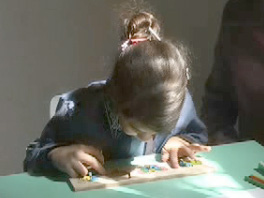 We should become accustomed to observe how much and how often the child uses tactile and haptic information to support visual information. Sometimes the tactile checking is so swift that it is easily missed. The short video shows a tactile confirmation of the form.
Some children, who have normal visual functioning for awareness of space and moving and even for recognition of some objects, may not have recognition functions for the forms used in testing vision and explore the forms tactily. These “sighted blind” children need a thorough assessment of all visual functions and good follow-up for early intervention. Watch the video.
[ Instructions I Paediatric Vision Tests I Vision Tests ]
This document was last modified on