LEA Rectangles Game
#254600

The LEA Rectangles Game contains two groups of rectangles with different shades of grey. The total surface area of each rectangle is the same. This set of rectangles is a modification of Efron's rectangles and was designed to allow observations on a child's ability to see differences in size. To make the test situation child friendly the test is performed as if we were playing with building blocks.
Show the longest and the shortest rectangle to the child and ask him to feel them using tactile and haptic information. Explain that the one that he can feel outside the other one we call longer and the other we call shorter. If the child can learn the concepts longer - shorter using tactile and haptic information then the basic concept is there. If the child even then cannot visually discern which one of the rectangles is the longer one, then you can test further using all the rectangles.
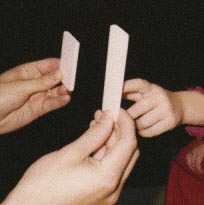 A normally sighted child can tell you which of the two rectangles is the longer and which one is the shorter, often before the age of three years, as the girl in the adjacent picture. If this is difficult or the child does not understand what you mean, you can use the LEA Rectangles Game to find out whether the child has a specific visual problem.
Instructions
This game was taughed to me by the boy whose hand you see in the picture. After I had tested him in my usual way, he said to me "Lea, if you examine a child who is not as bright as I am, you could do this test like this:"
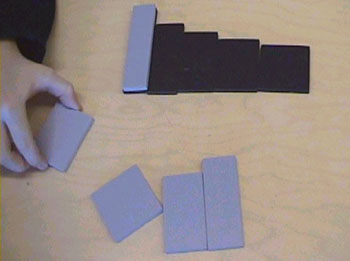
Place the dark rectangles on the table to form stairs.
Place the grey rectangles on the table around the stairs, not in the same order as they are in the stairs.
-
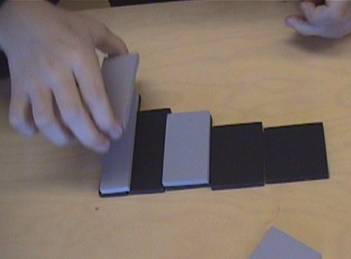
Ask the child to place the grey rectangles on the black rectangles so that each of them is laid on the black rectangle of the same length.
-
Then you see how he searches for the grey rectangle, then how he grasps it and how he puts it on the black rectangle. Does it go on the correct one or not. This picture was taken when he explained the new technique for testing.
This bright boy with severe CP had understood what I told him while we were playing. We want to learn how easy it is for the child to perceive which of the rectangles are of the same length (purely visual task in the ventral stream) and how exact is the distance between the index finger and the thumb when grasping the rectangle (visuomotor task in the dorsal stream).
If the child does not perceive the length visually he matches the rectangle tactily with several rectangles to find the correct one.
If he has difficulties with the parietal planning of the size to be grasped, the hand movements are clumsy. You may test this separately by demonstrating to the child how you grasp a rectangle slowly and carefully touching it at the ends of the longer axis. Place the rectangle on your palm and ask the child to grasp it gently and carefully.
If a child has primary motor problems the function of the hand is observed by the child's physiotherapist who can better assess the limitations of the motor function of the child's hand.
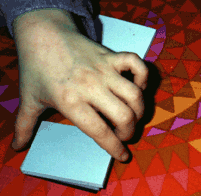 A child grasping a rectangle has correct distance
between the fingers before touching it,
i.e. there must be proper visual guidance of the
hand movements.
A child grasping a rectangle has correct distance
between the fingers before touching it,
i.e. there must be proper visual guidance of the
hand movements.
Damage to different cortical functions can be circumscribed. A child may have loss of one function of two rather similar functions if they are located in different areas of the visual cortices.
For more information on the visual functions click on Visual Pathways.
Reference:
Efron R. What is perception? Boston studies Phil.Sci. 1969, 4:137-73.
[ Instructions I Paediatric Vision Tests I Vision Tests ]
This document was last modified on