
#254500
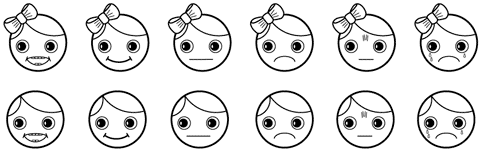
The Heidi Expressions Test Game (#254500) has been developed to improve early evaluation of vision for communication. Among the vision impaired children there are some who cannot see expressions and/or do not recognize people by their faces. These children may have nearly normal results in routine vision tests (i.e. large visual field and normal or near normal visual acuity.) Other vision impaired children may have this deficit in visual recognition as a part of more extensive loss of visual functions.
Many children have Cerebral Palsy, which may be so mild that it has not required special treatment. If the child's difficulties are not known and understood, his/her behavior may cause misunderstandings and needless negative experiences in social interactions. Therefore, testing of a child's ability to see differences among different facial expressions is an important part of functional visual assessment.
Vision impaired children have two different kinds of problems in learning to recognize faces and to interpret:
-
they do not see expressions well enough to interpret
them (=pathway problem) or
- they have brain damage in the area of face recognition and, therefore, do not recognize differences in people's faces and may also have difficulties in interpreting expressions (= cognitive visual problem). These children are unable to gather information related to faces from the visual information entering the brain because the normal Top-Down demand for face information does not exist. They are unaware of faces.
These children should be diagnosed early so that we can use other functions to support their development in communication. The Heidi Expressions Test Game should be included in the assessment of early visual processing whenever a child has symptoms of face blindness.
| A. Video 1 | B. Video 2 | |
 |
 |
|
| C. Video 3 | D. Video 4 | |
 |
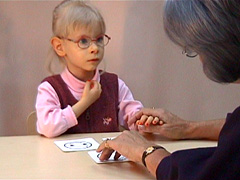 |
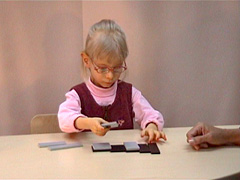
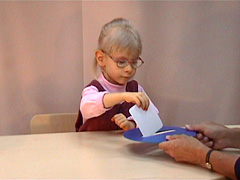
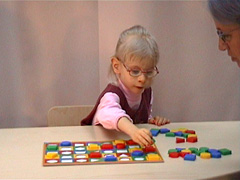
Before assessing the higher cortical functions it is advisable to test how the child recognizes components of pictures. A. This child grasped the rectangles correctly and placed them on rectangles of the same length. B. Similarly the “Mailbox” game showed normal perception of orientation of the slot on the test. Wrist rotation was still difficult; therefore, the test was presented horizontally. C. Colorama game requires simultaneous recognition of color and form. Also this task was easy. D. Despite normal looking components of picture perception and recognition, simple pictures of faces caused surprise and confusion in the mind of this bright girl. This question was too difficult: “In which picture in front of you is the mouth like the mouth in my card?“ Drawing the form of the mouth with the child’s own finger did not help the child in understanding what I was talking about. She had never looked at faces and, thus, had no skills to analyze them.
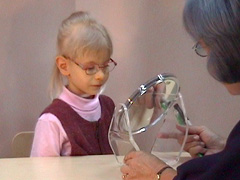
The structure of the face needs to be taught as a foreign language. We must keep in mind that the child does not have the expressions that we are accustomed to using. We need to start studying faces and expressions as pictures and use tactile information to support our descriptions. It is advisable to demonstrate some of the training situations as a part of the assessment: Magnifying mirror (E) combined with good make-up on the child and adult and tactile information from the movements of facial muscles makes the child aware of what happens on the face during communication. During a training session, an 8-year-old child asked, “Does the voice come through the mouth?” The answer was, “Yes, why do you ask?” The Child responded: “I have always thought that voice comes through the ears.” These children are often poorly aware of their body parts and if motion perception is weak or absent, lip movements are not seen. The lower part of the face can be seen as blurred and so unpleasant that the child looks past the person speaking but looks at him when answering. If accommodation is weak and the child seems to look through the person, the child’s behavior is assessed as autistic avoidance of eye contact and communication.
| E. | F. Video 5 | |
 |
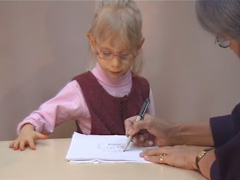 |
Drawing of pictures of faces (F) with the child is fun if the child tells what to draw and may even point to the part of the picture where the detail should be drawn.
G.
At the age of 4 years many children start to understand the value of carefully looking for all details around the faces and also on faces, especially spectacles and ear rings. Still in kindergarten, tactile pictures of faces are useful material in learning about structures of faces and facial expressions. The child is the same child as in figures A – F; in this picture at the age of 5 years.
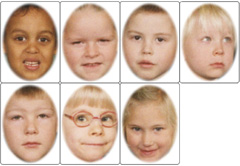
Pictures of the child’s peers are good material for testing perception and recognition of faces. Each picture is edited so that only the face is visible. During testing we do not describe any of the pictures but ask, “Do you know the children who are in these pictures?” This question was asked of the child in A-G at the age of 5 years. She had no clue although she had just played with these children. When she heard that the children were from her own group she answered, “Then I am in the middle of the lower row because I am the only child who has glasses.” She had learned to recognize glasses, but did not recognize her own face or her best friend’s face, who had the darkest face in this group photo.
It is possible to observe which type of problem the child
has during the Heidi Expressions Test Game. In some cases
the child may have poor quality of image and poor facial recognition.

The Heidi Expressions Test Game contains six different basic
expressions (see under the main heading.) Each expression is
on two identical cards and on a third card which
has one additional feature, a bow on Heidi's hair. In
this picture are the sets of three cards depicting smiling
Heidi and sad Heidi.
Play situation:
The Heidi Expressions Test Game can be used from the age of 30-36 months when teaching the child how people look when they have the six basic expressions depicted on the cards. Matching the cards gives a natural situation to discuss the different expressions.
Depending on the child's age and communication level, the matching game is varied. First the cards are used for matching; i.e., to see whether the child can use the pictures like other pictures that he/she is accustomed to recognising. It is often easiest not to mention that the pictures represent faces. If the child can match the pictures, the tester and child can look at the pictures and start talking about faces and facial expressions. The tester and the child may make the expressions themselves with their own faces. With an older child it is possible to reflect upon the causes why Heidi might be glad, sad, serious or weeping.
During this discussion it is possible to observe whether the child has to first look closely at the cards and then the tester's face to see the expressions, or whether the child seems to have difficulties in understanding the concept of facial expressions. The child may need to feel the facial features of the tester's face to perceive the expressions and to recognize them.
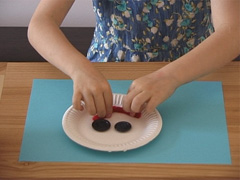
Drawing pictures of faces can be combined with the Heidi Expressions Test Game. Draw the circle and the eyes and ask the child "Which expression does Heidi have this time?" The child may draw the mouth or the tears, assisted by the tester when needed. This is another effective way to make the child aware of the structure of expressions. At the same time it can be used to create picture perception; i.e., to teach the child to understand how a picture represents an object. Expressions can also be created by using pipe cleaners for the mouth and buttons for the eyes glued on a small paper plate as an activity in nursery or kindergarten. The child's creations can be used to observe which features the child uses in the recognition of his/her picture.
When the child seems to understand the six different basic expressions, the cards can be matched. First only six cards are chosen, for example the smiling Heidi cards and the weeping Heidi cards. If the child does not have cognitive visual functions for facial recognition, he/she may match the faces with the bow as equal. This needs to be discussed with the child by showing once more on the tester's face how the different expressions look. The child may be able to see the expressions in a real-life situation although they are too difficult to be recognised in a picture.
By combining the information gathered in the different play situations, we learn a lot about the child’s ability to see and interpret facial features and expressions. Then we can support his/her learning in this area, which is central in every day social interactions.
If a child is found to not recognize faces and/or facial expressions in these black & white cards, testing is continued using colour photographs and real-life situations. Each child who deviates from normal behaviour in interaction with peers and family members needs a thorough assessment of vision for communication. In a group of children the child may need an interpreter/intervener because in that situation he/she may be functionally blind even if he/she functions normally in other visual tasks. Without help, the play situation in a group of children may be so stressful and confusing that the child will prefer to withdraw and, thus, may be diagnosed as having "autistic behaviours".
Difficulties in perception and interpretation of facial expressions should be diagnosed early and early intervention should be started without delay. Training as a part of other therapies should continue through all school years and should cover blind techniques. Even if the children learn to remember details that are typical to most people, this analytic way of recognising is much slower than the normal instant recognition of faces and feeling-in in. The delay in responses is often experienced as emotional coldness if the visual problem is not known.
[ Instructions I Paediatric Vision Tests I Vision Tests ]
This document was last modified on