LEA SYMBOLS®
Distance Visual Acuity Chart
#250150
This non-translucent LEA chart is the original distance chart for kindergarten children (#250150) designed in 1976 and printed first in Finland and since early 1990s in the USA. They are used in vision screening and in assessment of visual functioning in numerous countries. They have their black reverse side, which can be used as the background in the Panel 16 colour vision testing or in the LEA Rectangles test.
During assessment of vision of visually impaired individuals this chart can be used at shorter distances, even as a near vision test. Testing uses the same principles as testing at near distances.
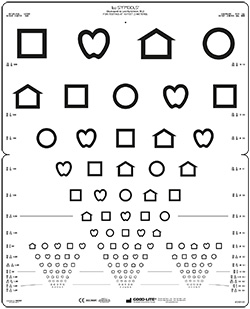
When examining young children, introduce the distance chart to the child after near testing by saying, "Let's look at the same pictures a little further away." Move the chart gradually back to 3 meters (10 feet), while watching the child for signs of inattention. If the child loses interest, move closer to 1.5 meters (5 feet) or one meter (40 inches). Always test well within the cognitive visual sphere of the child, the space within which the use of vision is possible. Older typically developing children may be switched directly from a near vision test to a 3-meter (10-foot) chart.
Instructions
-
Establish a method of communication such as naming (signing) or pointing (matching). Decide with the child which names will be used to identify the symbols. When needed, train with the LEA 3-D Puzzle (#251600), Response Key Card (#251700), or Flash Cards (#251800).
-
Cover the line above the line to be read with a white card and ask the child to identify the first symbol in each line in descending order when testing binocularly. Do not point to the symbol to be read because it makes fixation easier, especially in case of amblyopia (lazy eye).
-
Move down until the child hesitates or misidentifies a symbol.
-
Move back up one line and ask the child to identify all the symbols on that line.
-
If the child identifies all symbols correctly go to the next line with smaller symbols and ask the child to identify all symbols on the line.
-
If the child skips a symbol, ask the child to try again while briefly pointing to that symbol and saying “You jumped over this picture between (e.g.) ‘house’ and ball’.” What is it?”
-
A child with an amblyopic eye or irregular saccades may typically skip symbols within a line of symbols. If skipping symbols occurs, report whether it occurred in only one eye or in both eyes.
-
Visual acuity is recorded as the last line on which at least 3 of the 5 symbols are identified correctly.
-
When tested at 3 meters (10 feet) the visual acuity value is found in the margin adjacent to that line.
-
After obtaining good responses with binocular testing, proceed by testing each eye separately.
-
When testing monocularly, use the first symbol of each line or every second line for one eye and the last symbol of each line for the other eye to determine on which line to start testing. Then move to the small sets of test lines on each side and test the same way as when using the middle set of test lines. This way the child cannot memorise the chart. Use the right set of symbols for the testing of the right eye and the left for testing the left eye.
- Always remember to record which test you used and at which distance. This makes the follow-up more reliable, even if the child moves to another school and will be tested by another school nurse and another doctor.
Testing at Different Distances
If the chart is used at a distance other than the usual 3 meters (10 feet), measure and record the viewing distance and the symbol size (the M value) or the visual acuity value printed at the threshold line.
To determine the visual acuity use one of the following formulas:
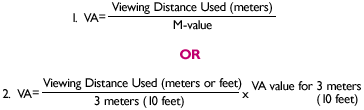
Note that it is incorrect to report 'V.A. 20/25 at 5feet' if the child could read the 20/25-line (3.8M line) at 5 feet. Visual acuity is in that case: 5'/10' x 20/25 = 1/2 x 20/25 = 20/50. (When using the British notation: 6/9 line at 150cm equals: 1.5m/3m x 6/9 = 1/2 x 6/9 = 6/18. When using the decimal notation 0.8 at 1.5m equals: 1.5m/3m x 0.8 = 1/2 x 0.8 = 0.4)
When the distance is one half (or one third) of the standard distance, the visual acuity value is also one half (one third) of the value printed next to that line.
In the rare cases where the child/person can read all optotypes correctly on the 2.0 (20/10, 6/3) row and none on the 2.5 (20/8.0, 6/2.4) line, the test can be moved to a slightly shorter distance to record the threshold level. At a distance of 2.76 m the visual acuity value of the 2.5 line is 2.3 (20/8.7, 6/2.6).
During the measurement of visual acuity you can also learn about other aspects of the child’s visual functioning. For example, the boy in this video has so great difficulties in fixating and focusing that he sighs when trying to recognise the first symbols of each line well above his threshold value. If looking at forms to recognise one out of four possible symbols is demanding, how difficult will it be to try to fixate and focus on words?
M-unit, metric unit is the distance in meters at which the reference optotype C is seen at a visual angle of 5'.
[ Instructions I Paediatric Vision Tests I Vision Tests ]
This document was last modified on